

My Entire Sales Job Now Runs Inside Slack
Field Notes · the Slackbot Sales OS is live

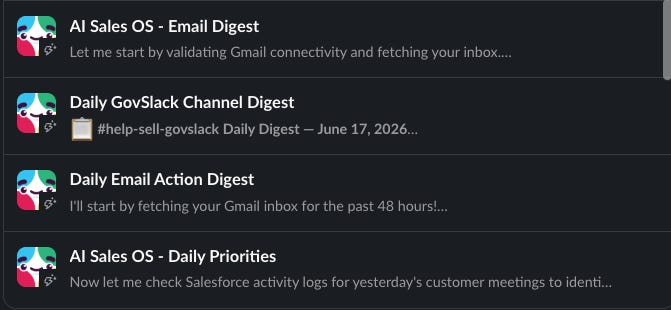
What’s waiting when I open Slack at 7am.
I opened Slack this morning and four messages were already waiting from my own bot. One had validated my Gmail connection and pulled the inbox. One ran a daily digest on a channel I follow. One fetched the last 48 hours of email and flagged what needed action. The last one was checking Salesforce activity logs for yesterday’s customer meetings to figure out what I should do today.
I hadn’t typed anything. It just runs.
For the last few months I’ve been building a sales operating system inside Slack, one skill at a time. It’s the real thing I work out of every day. This week it crossed the line from “thing I’m building” to “thing that runs whether I show up or not,” so it felt like the right time to write down how the whole thing fits together.
Two rhythms, two chains
Sales work splits cleanly into two kinds of time.
There’s the quarterly work. The stuff you do once when you inherit a territory or start a new year, then mostly forget until the next planning cycle. And there’s the daily work, the live execution of moving deals forward. Most “AI for sales” content only ever touches the second kind, and usually just one piece of it. I wanted skills for every step of both.
So the system has two chains.
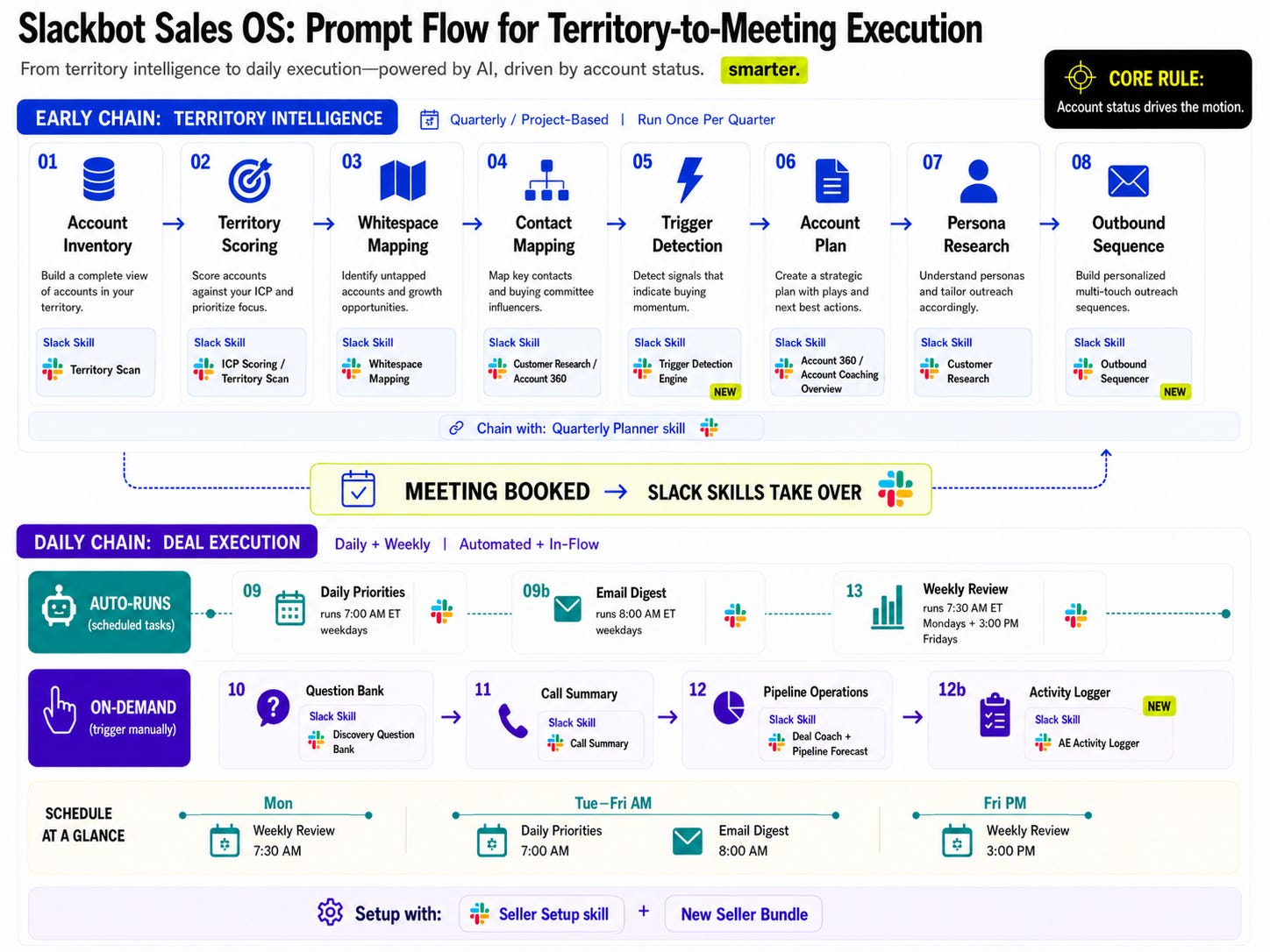
The whole system, one diagram. Early chain on top, daily chain on the bottom.”]
The early chain: territory intelligence
This one runs once a quarter. Eight skills, in order, each output feeding the next step’s input.
It starts by building a complete account inventory for my territory. Then it scores those accounts against my ideal customer profile so I know where focus belongs. From there it maps the whitespace, finds the key contacts and the buying-committee influencers, and detects the signals that say an account is heating up. It drafts a strategic account plan with next best actions, researches the personas I’m about to reach out to, and ends by building a personalized, multi-touch outbound sequence.
One rule sits underneath the whole chain: account status drives the motion. Where an account sits tells the system what to do with it. I’m not making a hundred small judgment calls. The status makes most of them for me.
The output of that chain is a territory I understand and a set of sequences ready to send.
The handoff
Then something works. A meeting gets booked.
That’s the single point where the two chains connect. The moment a meeting lands, the daily skills take over and carry the conversation from there.

The daily chain: deal execution
This is the half that now runs on a schedule without me.
At 7am on weekdays, a Daily Priorities skill checks my Salesforce activity logs, looks at yesterday’s meetings, and tells me where the day should go. At 8am an Email Digest validates the inbox connection, pulls recent mail, and surfaces what needs a reply. Monday at 7:30 and Friday at 3, a Weekly Review runs the same way. Those are the auto-runs. I don’t trigger them. They show up.
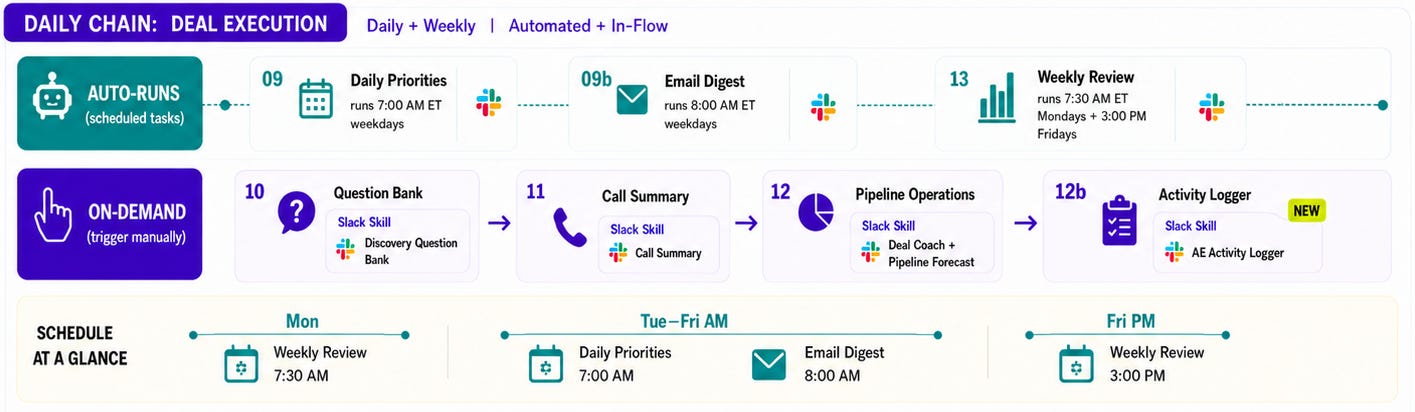
The daily side, on a schedule.
Then there’s a set I trigger by hand when the moment calls for it. A discovery question bank before a call. A call summary after. Pipeline forecasting and deal coaching when I’m working the number. An activity logger that writes the work back into Salesforce so I’m not doing CRM hygiene at 6pm.
There’s a whole library of these skills now. Deal Brief, Account 360, Account Coaching Overview, Account Resolver, the Activity Logger. I reach for them by name the same way I’d reach for a teammate who’s good at one specific thing.
The test I keep running it against
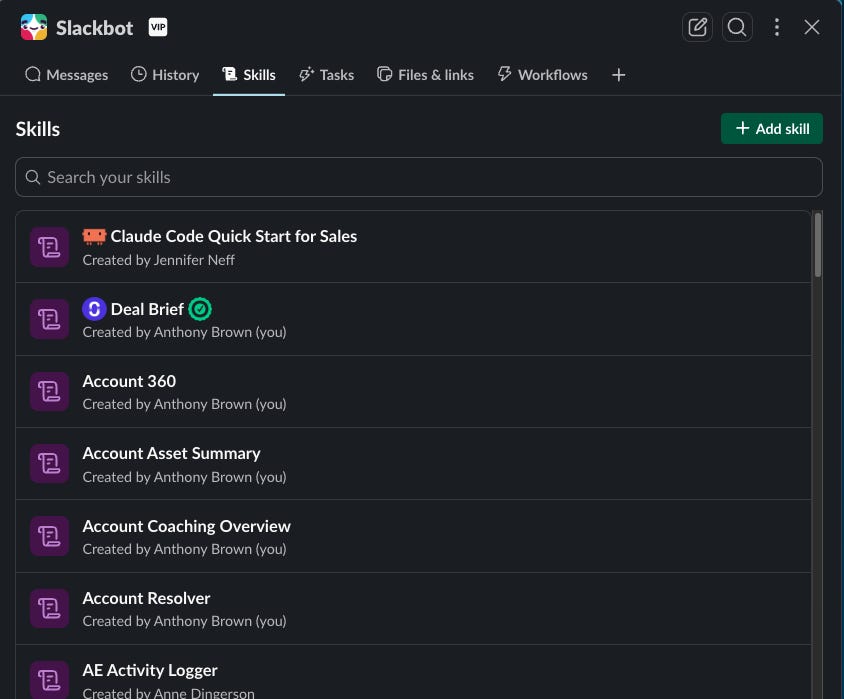
The skills a new seller would inherit on day one.
Here’s the question I use to know if it’s working: could a brand new AE sit down at this on day one and produce?
Not “could they learn the tools.” Could they open Slack and immediately know what to focus on, where their time should go, who to message, and how to keep every conversation moving forward? That’s the bar. The judgment that usually takes a couple of years to build is starting to live inside the flow itself, where a new seller can borrow it from the first morning.
That’s the part I care about most. Building the skills was the fun part, and the easy part. Getting a system to the point where it runs on its own, gets used over the old way, and survives a busy week, that’s the harder problem. It’s also the only one that matters. A skill nobody opens twice is just a demo.
This one gets opened every morning. So far, so does the rest of it.
Want one for your role?
The system above is built for a seller, but the method underneath it isn’t sales-specific. You map the role into its real steps, build a skill for each one, and then comes the hard part: getting it to run on a schedule so it survives a busy week. I’ve run that loop on my own job and a few others, and it holds up the same way every time.
If you want one of these inside your own Slack, that’s the work I do. We start by mapping your role into the two chains and naming the handful of skills worth building first. Then we build them where your work already happens and get them to stick.
Two ways in. Want to build it yourself?
Subscribe — the newsletter ships skill templates and role blueprints as I write them.