

Stop Wasting Your Claude Limits
▶ FIELD NOTES · TOOL DEEP-DIVE

Anthropic now gives you four models in the picker: Haiku 4.5, Sonnet 4.6, Opus 4.8, and the new Fable 5. Most people I see do one of two things. They never touch the dropdown, or they run everything on the biggest model because bigger must be better.
Both approaches burn the same thing: your usage limits, spent on the wrong work.
Here’s the 2-second fix. Ask yourself: what does it cost you if the output is wrong?
If wrong means a quick retype or a rerun, go small. If wrong means a bad decision in front of a customer, your VP, or your team, go big.
That’s the whole framework. Everything below is just that question applied four times.
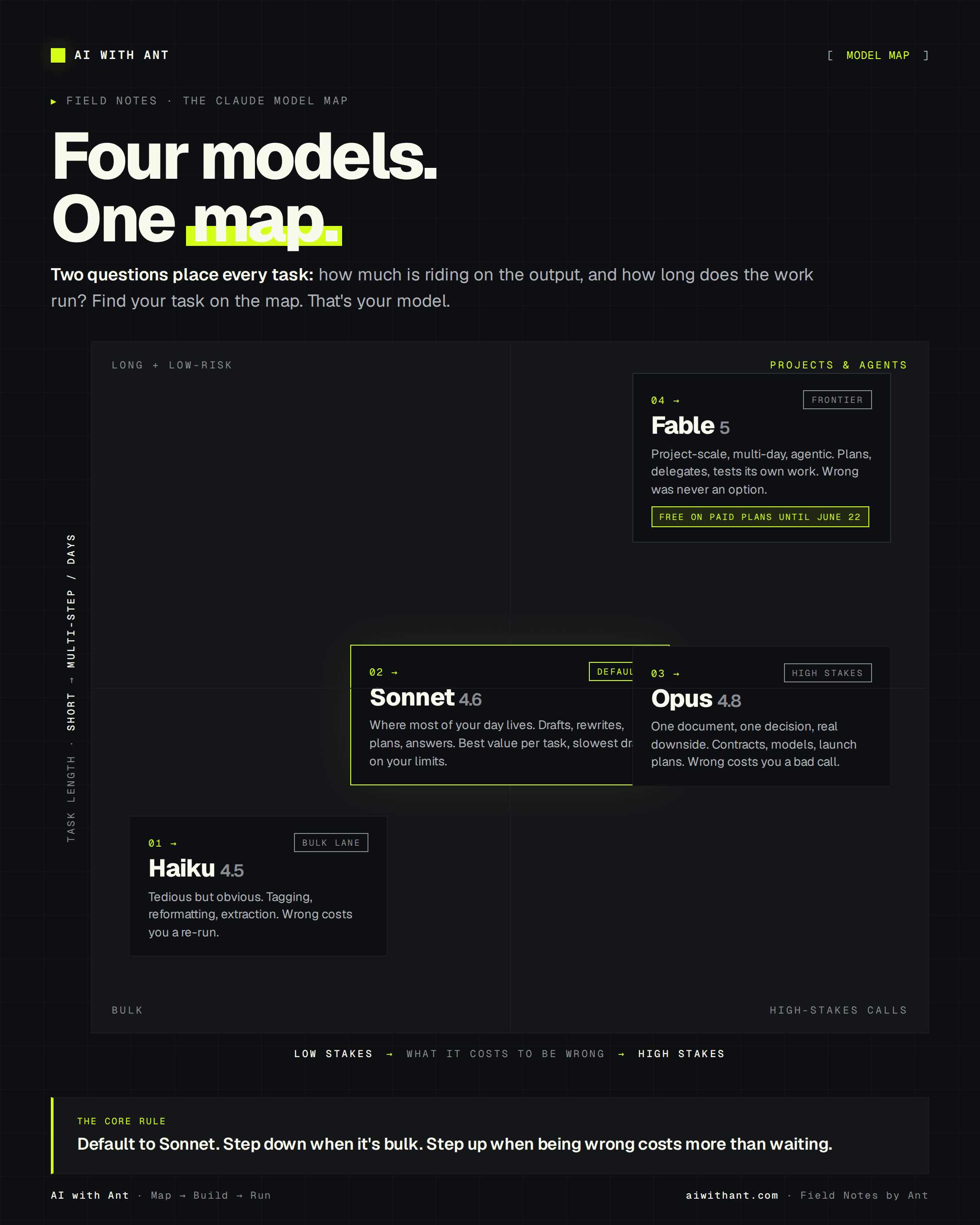
Haiku 4.5 — the bulk lane
Haiku is the fastest and cheapest of the four, and Anthropic says it matches older Sonnet-tier performance on a lot of coding and agent tasks. It’s built for high-volume work where wrong costs you a few seconds, not a few hours.
Think extracting action items from long email threads. Cleaning notes into tables. Tagging a few thousand records. If you’d describe the task as “tedious but obvious,” Haiku does it in seconds and barely touches your limits.
Use Haiku when you’re doing bulk classification, tagging, or format conversion. Use it when you’re summarizing low-risk content for your own understanding, and the worst-case outcome is “I run it again.”
Skip it the moment a task needs judgment, nuance, or more than one real reasoning step.
Sonnet 4.6 — the default
Sonnet is the workhorse, and it’s where most of your day should live. Drafting posts. Rewriting emails in your voice. Turning meeting notes into plans. Summarizing long docs with actual context. It delivers the best quality per token for general work, which matters if you’re in Claude all day and care how fast your credits disappear. I am, and I do.
Use Sonnet when the output touches other people but isn’t life-or-death. Use it when you want strong reasoning and style control without paying Opus or Fable rates, and when you’re iterating fast enough that speed plus quality beats absolute depth.
Only leave Sonnet for the hardest 10% of your work.
Opus 4.8 — high stakes
Opus is slower on purpose. It thinks longer and earns that back in accuracy on multi-step work where correctness is the whole point.
Use it where errors compound: pressure-testing a launch plan, walking a contract clause by clause, building a financial model where one bad assumption poisons everything downstream.
I treat Opus like a senior reviewer. Not for everything, but for the work I can’t afford to redo. If you’re making a decision you can’t easily undo, or reviewing something dense with real downside, this is the tier.
Fable 5 — the agent
Fable is the new one, and it belongs in a different category than the other three. It’s Anthropic’s first Mythos-class model made generally available; the Mythos line was previously restricted to a small set of approved partners. Where Opus thinks harder about one thing, Fable runs an entire project. It plans its approach, works for days inside an agent harness like Claude Code, delegates to sub-agents, checks its own progress, and refines until it hits the goal.
It’s also the priciest model Anthropic sells: $10 per million input tokens and $50 per million output, which is double Opus 4.8 at the token level. So don’t ask it what time zone Lisbon is in.
One thing worth knowing right now: Fable 5 is included on Pro, Max, and Team plans at no extra cost through June 22. If you want to feel the difference before it starts drawing from your credits, this is the window.
Five Fable builds that actually justify the tier
Here’s where Fable stops being a launch headline and starts looking like a different tool.
1. Codebase-wide migrations in a day. Anthropic says one fintech customer ran a migration across a roughly 50-million-line codebase in about a day, work they’d estimated at two months for an engineering team. Fable planned the migration, updated code across services, and kept tests in sync instead of patching one file at a time. You don’t need this tier for a bug fix. You reach for it when the job is “rewrite a core abstraction everywhere and don’t break anything.”
2. Multi-day autonomous coding runs. Earlier models could push a project forward if you built a lot of scaffolding around them. Fable maintains its own plan. Teams are handing it a repo, a goal, and some guardrails, then letting it work through multi-file features end to end without constant nudging.
3. Senior-analyst-grade research. Early finance benchmarks put Fable at senior-analyst-level reasoning on dense, document-heavy work. The interesting use isn’t “summarize this PDF” (Sonnet handles that). It’s the job that looks like what a senior analyst would do over a week: deep dives across filings, internal docs, and data tables, coming back with structured analysis, scenarios, and stress tests.
4. Vision-heavy reverse engineering. Anthropic has shown Fable reconstructing web apps from screenshots and pulling precise values out of dense charts and scientific figures. For basic OCR you’re overpaying. It earns the tier when the visual input feeds a bigger reasoning or coding task, like looking at a UI and proposing the code behind it.
5. Long-horizon agents for research and ops. Fable is showing up as the brain behind agents that pursue a goal across many steps: running experiments, reconciling conflicting sources, orchestrating internal workflows over days instead of giving one-shot answers. The closest comparison I’ve found is a junior team that keeps its own to-do list and actually works through it.

The rule I actually run
My routing is simple. Default to Sonnet. Step down to Haiku when it’s bulk and low-risk. Step up to Opus when the cost of being wrong is high in a single document or decision. Escalate to Fable when the task looks like a project a small team would own.
Then I try to remove the decision entirely.
Limits got reshaped this year and Fable runs at twice Opus’s token price, so model choice now has real economic weight. Inside my own systems, the routing is baked into the tools. The daily Slack skills run light. Most work defaults to Sonnet. Only top-risk or project-scale tasks dispatch to Opus or Fable.
Because in the moment, people don’t optimize. They click whatever’s selected. Defaults beat decisions, and that’s exactly where most AI rollouts stall: the demo was great, but nobody wired in sane defaults. That’s a RUN-phase problem, and it’s the part almost nobody teaches.
Set your default once. Encode the routing into your workflows. Let the picker fade into the background.
If you’re done treating AI like a chat box: I map roles into AI Operating Systems. Map. Build. Run. A MAP Session is 75 minutes and you leave with your role rendered as a system blueprint. Reply to this email if you want one.
— Ant